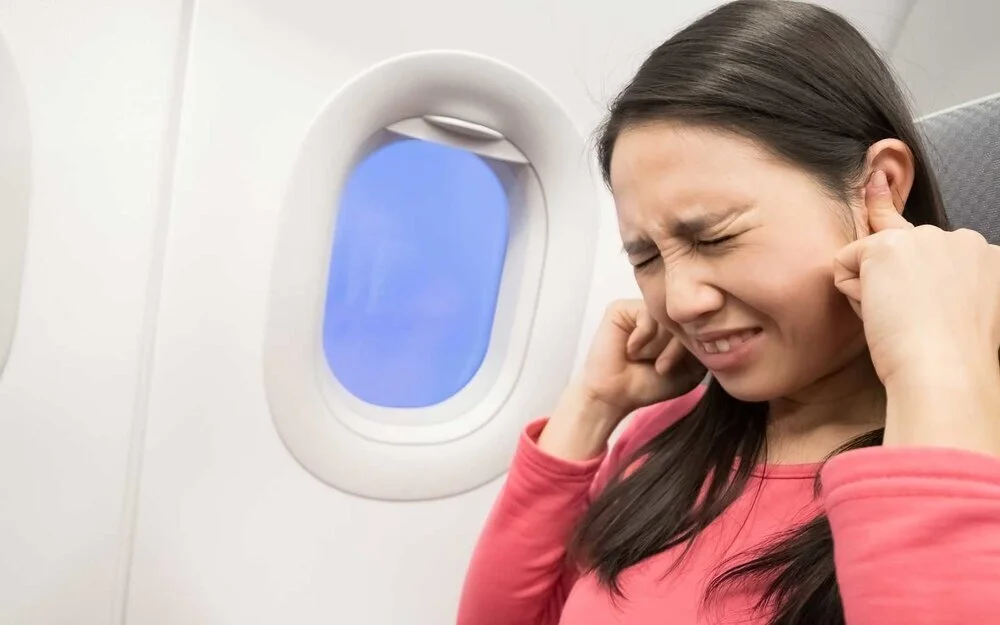
The Complete Guide to Ear Pressure Relief
Understanding Pressure Equalization, the Eustachian Tube, and What Really Works
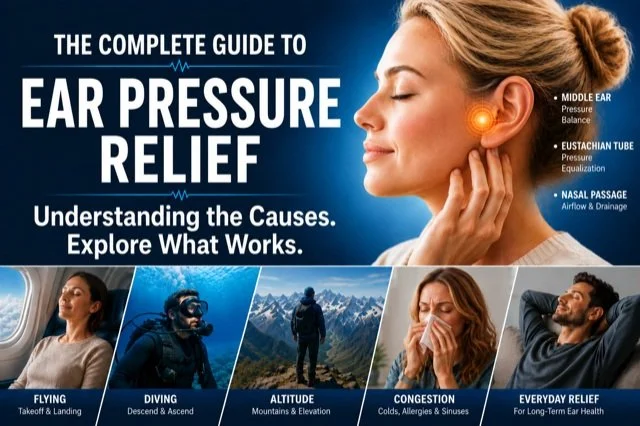
Millions of people experience uncomfortable ear pressure every day. Whether you're descending on an airplane, driving through the mountains, scuba diving, recovering from a cold, or struggling with seasonal allergies, that familiar sensation of blocked ears can range from mildly annoying to surprisingly painful.
For some people, it lasts only a few moments. For others, it can persist for hours or even days, affecting hearing, balance, comfort, and overall quality of life.
Yet despite how common ear pressure is, many people don't fully understand why it happens or how to relieve it effectively.
The good news is that in many cases, ear pressure isn't caused by a problem with the ear itself. Instead, it's often the result of your body's natural pressure equalization system not working as efficiently as it should.
Understanding that system is the first step toward preventing uncomfortable pressure changes before they become a problem.
This comprehensive guide explains:
Why ear pressure occurs
How pressure equalization works
The important role of the Eustachian tube
Common causes of blocked ears
Why your ears sometimes won't pop
What causes airplane ear
How allergies and sinus congestion affect ear pressure
Natural ways to relieve pressure
When you should seek medical care
Along the way, we'll also link to more in-depth articles that explore each topic in greater detail.
Whether you're an occasional traveler or someone who struggles with recurring ear pressure throughout the year, this guide will help you better understand what is happening inside your ears—and what you can do about it.
What Is Ear Pressure and Why Does It Happen?
Most people don't think about their ears until something feels wrong.
Your ears normally maintain a delicate balance between the pressure inside your middle ear and the air pressure around you. Under normal circumstances, this balance happens automatically without you even noticing.
Problems arise when the pressure outside your body changes faster than your ears can adjust.
This pressure difference creates tension across the eardrum, producing sensations such as:
Fullness
Pressure
Muffled hearing
Popping
Crackling
Discomfort
Pain
Fortunately, your body has a built-in system designed to manage these pressure changes.
This process is known as pressure equalization.
Why Pressure Changes Matter
Air pressure is constantly changing around us.
Although we don't usually notice these changes, they become much more dramatic during situations such as:
Flying
Scuba diving
Driving through mountains
Riding elevators in tall buildings
Rapid weather changes
Descending into valleys
Hyperbaric chamber treatments
Every time outside pressure changes, your middle ear must adjust to match it.
When it does, everything feels normal.
When it doesn't, you experience the symptoms commonly referred to as ear pressure.
Your Ear Is Actually Three Different Parts
Many people think of the ear as a single organ.
In reality, it consists of three distinct sections, each with an important role.
The Outer Ear
The outer ear includes the visible ear and the ear canal.
Its primary job is collecting sound and directing it toward the eardrum.
The Middle Ear
Behind the eardrum sits a small, air-filled chamber known as the middle ear.
This tiny space contains three of the smallest bones in the human body, which transmit sound vibrations from the eardrum to the inner ear.
For these bones to move freely, the pressure inside the middle ear must remain balanced with the surrounding environment.
This is why pressure equalization is so important.
The Inner Ear
The inner ear converts sound vibrations into electrical signals that your brain interprets as hearing.
It also contains structures responsible for balance and spatial orientation.
Although many people blame the inner ear for pressure problems, most common ear pressure issues actually begin in the middle ear.
(LEARN MORE)
How Pressure Equalization Works
One of the body's most fascinating systems operates almost entirely without conscious effort.
Every few minutes—and especially when you swallow, yawn, or chew—your body automatically attempts to equalize pressure inside your ears.
Most people never notice this happening.
The process is fast, efficient, and remarkably effective.
Problems only develop when this natural system becomes temporarily overwhelmed or partially blocked.
What Is Pressure Equalization?
Pressure equalization is the process of balancing air pressure on both sides of your eardrum.
Imagine your eardrum as a flexible membrane separating two environments:
The ear canal (outside pressure)
The middle ear (inside pressure)
When pressure is equal on both sides, the eardrum moves normally, allowing you to hear comfortably.
When pressure becomes uneven, the eardrum stretches inward or outward.
That stretching produces the familiar sensation of blocked ears.
Why Your Ears Pop
Many people assume that ear popping is the problem.
In reality, popping is usually a sign that your pressure equalization system is doing exactly what it is supposed to do.
The "pop" occurs when a small amount of air moves through the pressure equalization pathway, restoring balance inside the middle ear.
Afterward, hearing often becomes clearer almost immediately.
The uncomfortable pressure disappears.
Why Sometimes They Don't Pop
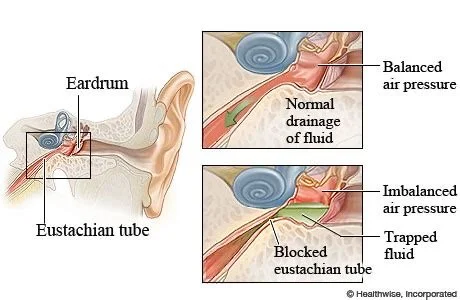
If that pathway becomes swollen, narrowed, or temporarily blocked, air cannot move freely.
Pressure remains trapped.
The longer that imbalance persists, the greater the discomfort becomes.
This is why ear pressure is often associated with:
Flying
Allergies
Sinus congestion
Colds
Upper respiratory infections
Although these conditions seem unrelated, they often affect the same pressure equalization system.
In the next section, we'll examine the small anatomical structure that makes all of this possible—and why it plays such a critical role in maintaining healthy ear pressure.
What Is the Eustachian Tube and Why Is It So Important?
If ear pressure relief had a "main character," it would be the Eustachian tube.
Although most people have never heard of it until they experience problems, this small passageway is responsible for one of the most important functions in ear health: maintaining balanced air pressure in the middle ear.
When it works properly, you rarely notice it.
When it doesn't, simple activities like flying, driving through mountains, or recovering from a cold can become surprisingly uncomfortable.
The Eustachian tube acts as your body's natural pressure regulator, allowing tiny amounts of air to move between the middle ear and the back of the nose and throat. Each time it opens, it helps restore pressure balance and keeps the eardrum moving normally.
Understanding how this tube functions—and what can interfere with it—is the key to understanding nearly every common ear pressure problem.
Want to dive deeper? Read our complete article: What Is the Eustachian Tube and Why Does It Matter?
Why Won't My Ears Pop?
Few travel frustrations are more common than feeling like your ears simply won't pop.
You've tried swallowing. You've yawned repeatedly. Maybe you've chewed gum or sipped water throughout the flight. Yet your ears still feel blocked, your hearing sounds muffled, and the pressure refuses to go away.
The truth is that your ears don't "pop" because of the ears themselves—they pop because your body's pressure equalization system is successfully balancing pressure inside the middle ear.
When that system isn't working efficiently, pressure becomes trapped.
The result is the uncomfortable sensation of plugged ears.
Why Your Ears Usually Pop Without You Noticing
Throughout the day, your Eustachian tubes open hundreds of times.
This happens naturally when you:
Swallow
Yawn
Talk
Chew
Drink
Each opening allows a tiny amount of air to move into or out of the middle ear.
Most of the time, these pressure adjustments are so subtle that you never notice them.
Only during larger pressure changes—such as flying or driving through mountains—does the equalization process become obvious.
Common Reasons Your Ears Won't Pop
Several factors can interfere with normal pressure equalization.
Nasal Congestion
Inflammation inside the nasal passages can extend toward the opening of the Eustachian tube, making it more difficult for air to move freely.
Seasonal Allergies
Allergic reactions often produce swelling and excess mucus that may temporarily narrow the Eustachian tube.
Colds and Upper Respiratory Infections
Even a mild cold can significantly affect pressure equalization because tissues surrounding the Eustachian tube become inflamed.
Sinus Inflammation
The sinuses and Eustachian tubes share nearby anatomy.
When the sinuses become inflamed, normal airflow and pressure regulation may also be affected.
Anatomical Differences
Some individuals naturally have narrower or less efficient Eustachian tubes, making them more susceptible to recurring pressure problems.
When Pressure Remains Trapped
If pressure cannot equalize, you may experience:
Ear fullness
Muffled hearing
Pressure
Crackling
Pain
Temporary hearing changes
Fortunately, most cases improve once the underlying pressure imbalance resolves.
Learn more: Why Won't My Ears Pop?
What Causes Ear Popping?
Many people worry that popping sounds indicate something is wrong.
In fact, popping is often a healthy sign.
The sound occurs when pressure is successfully equalized across the eardrum.
Think of it as a pressure-release valve opening briefly.
Once pressure equalizes, hearing typically becomes clearer and discomfort improves.
Normal Ear Popping
Healthy ear popping commonly occurs:
During flights
While driving through mountains
While scuba diving
During elevator rides
While swallowing
While yawning
In most cases, popping indicates normal pressure regulation.
When Popping Becomes Excessive
Frequent popping accompanied by:
Pain
Hearing loss
Persistent fullness
Ringing
may indicate an underlying pressure equalization issue that deserves further evaluation.
Learn more: What Causes Ear Popping?
Airplane Ear: Why Flying Causes Ear Pressure
Air travel exposes the ears to one of the fastest pressure changes encountered in everyday life.
Although commercial aircraft maintain cabin pressurization, the pressure inside the cabin still changes substantially during both ascent and descent.
Your ears must continually adapt.
Why Takeoff Feels Different Than Landing
During takeoff, cabin pressure gradually decreases.
Air inside the middle ear usually escapes relatively easily.
As a result, many travelers experience only minor discomfort.
Landing is different.
As the aircraft descends, cabin pressure increases.
Now the middle ear must allow air back inside.
If the Eustachian tube doesn't open efficiently, pressure becomes trapped.
This explains why descent is responsible for most cases of airplane ear.
Common Symptoms
Airplane ear may include:
Ear pressure
Fullness
Pain
Muffled hearing
Crackling
Ringing
Temporary hearing reduction
Most symptoms resolve shortly after landing, although some may persist for several hours.
Who Is Most Likely to Experience Airplane Ear?
Risk increases if you:
Have allergies
Have a cold
Experience sinus congestion
Have chronic Eustachian tube dysfunction
Frequently travel by air
Have recently recovered from an upper respiratory illness
Children are also more susceptible because their Eustachian tubes are smaller and less developed.
Read our complete guide: Airplane Ear: Causes, Prevention, and Relief
Best Ear Pressure Relief for Flying
The most effective approach is preventing pressure buildup before it becomes severe.
Rather than waiting until your ears become painfully blocked, support your body's natural pressure equalization process throughout the flight.
Before Your Flight
Many experienced travelers prepare by:
Staying hydrated
Managing allergy symptoms when appropriate
Avoiding unnecessary air travel when seriously ill
Beginning pressure equalization before descent
During Takeoff
Simple habits can encourage natural pressure equalization:
Swallow frequently
Drink water
Chew gum
Yawn often
These activities activate muscles that help the Eustachian tube open.
During Landing
Landing deserves special attention because pressure changes occur more rapidly.
Helpful practices include:
Remaining awake
Swallowing frequently
Continuing gentle equalization techniques
Avoiding forceful blowing
Many travelers find that beginning these techniques before the aircraft starts its final descent provides the greatest benefit.
Complete article: Best Ear Pressure Relief for Flying
How to Unclog Ears After a Flight
Sometimes pressure doesn't equalize immediately after landing.
Although this can be frustrating, it is often temporary.
The body usually continues attempting to restore normal pressure over the next several hours.
What You Can Do
Helpful strategies include:
Continue swallowing
Stay hydrated
Yawn repeatedly
Walk around after arriving
Give your ears time to recover naturally
What You Should Avoid
Avoid repeatedly forcing pressure into your ears.
Excessive force can sometimes worsen discomfort.
Gentle, patient pressure equalization is usually more effective than aggressive attempts to "pop" the ears.
When Symptoms Last Longer
Most cases improve within hours.
If symptoms persist for several days, worsen significantly, or include severe pain, drainage, bleeding, or noticeable hearing loss, professional medical evaluation is recommended.
Learn more: How to Unclog Ears After a Flight
How These Topics Fit Together
At first glance, blocked ears after a flight, allergies, sinus congestion, and ear popping may seem unrelated.
In reality, they all involve the same pressure equalization system.
Understanding that connection is one of the most important lessons in managing recurring ear pressure.
How Sinus Congestion Affects Ear Pressure
One of the most common reasons people experience blocked ears has nothing to do with the ears themselves.
Instead, the problem often begins in the nose and sinuses.
When the tissues inside the nasal passages and sinuses become inflamed—whether from a cold, allergies, or a sinus infection—that inflammation can affect the opening of the Eustachian tube. Even mild swelling may interfere with your body's ability to equalize pressure efficiently.
This is why many people notice that whenever they become congested, they also experience:
Plugged ears
Muffled hearing
Difficulty popping their ears
Increased pressure during flights
Ear discomfort while driving through mountains
Although these symptoms can feel like an ear problem, they're frequently the result of inflammation surrounding the pressure equalization system.
Why Congestion Makes Pressure Worse
The Eustachian tube depends on being able to open and close normally.
When nearby tissues become swollen, the tube may not open as efficiently.
As a result:
Air cannot move freely into or out of the middle ear.
Pressure differences remain trapped.
The eardrum cannot move normally.
Hearing may temporarily become muffled.
For many people, improving nasal health also improves ear comfort.
Learn more: Sinus Congestion and Ear Pressure Explained
How Allergies Affect the Eustachian Tube
Seasonal allergies are another major contributor to recurring ear pressure.
When your immune system reacts to pollen, dust, mold, pet dander, or other allergens, it produces inflammation designed to protect your body. Unfortunately, that same inflammatory response may also affect the tissues surrounding the Eustachian tube.
Many allergy sufferers experience:
Ear fullness
Pressure
Clicking or popping
Temporary hearing changes
Increased discomfort during flights
These symptoms often fluctuate with allergy seasons and may improve as inflammation decreases.
Managing Allergy-Related Ear Pressure
While everyone's situation is different, many people benefit from:
Limiting exposure to known allergens
Staying well hydrated
Following their healthcare provider's allergy treatment plan
Monitoring symptoms before air travel or altitude changes
Reducing inflammation may help your body's natural pressure equalization system function more effectively.
Learn more: How Allergies Affect the Eustachian Tube
Ear Fullness After a Cold
Have you ever recovered from a cold only to discover that your ears still feel plugged?
This is extremely common.
Even after congestion improves, inflammation around the Eustachian tube may take additional time to resolve.
As a result, pressure equalization may continue to be less efficient for several days—or occasionally longer.
Common symptoms include:
Fullness
Mild pressure
Muffled hearing
Occasional popping
Crackling sensations
Most cases gradually improve as normal function returns.
However, if symptoms become severe, continue to worsen, or persist for an extended period, you should seek evaluation from a qualified healthcare professional.
Learn more: Ear Fullness After a Cold
Can a Nasal Spray Help Ear Pressure?
Many people wonder whether a nasal spray can help relieve ear pressure.
The answer depends on the underlying cause.
Because the Eustachian tube opens in the back of the nose, maintaining healthy nasal tissues may support your body's natural pressure equalization process.
However, no single product is appropriate for every situation, and the effectiveness of any nasal spray depends on the reason for the pressure problem.
Understanding the Goal
The goal isn't to treat the ear directly.
Instead, the goal is to support the normal function of the pressure equalization pathway.
Depending on the situation, maintaining healthy nasal passages may help improve comfort during:
Air travel
Seasonal allergies
Mild congestion
Altitude changes
Always follow product directions and consult a healthcare professional if symptoms are severe, persistent, or accompanied by fever, drainage, significant hearing loss, or severe pain.
Learn more: Can a Nasal Spray Help Ear Pressure?
How to Relieve Ear Pressure Naturally
Many cases of mild ear pressure improve as your body's natural pressure equalization system restores balance.
Simple habits may encourage this normal process.
Gentle Techniques
You may find relief by:
Swallowing frequently
Yawning
Drinking water
Chewing gum
Remaining hydrated
Practicing gentle pressure equalization techniques
Avoid forcefully attempting to pop your ears, as excessive pressure may cause discomfort or injury.
Support Your Overall Ear Health
Healthy daily habits can also make a difference over time.
These include:
Staying hydrated
Managing allergies
Avoiding smoking and secondhand smoke
Addressing chronic nasal inflammation with appropriate medical guidance
Giving your ears time to recover after significant pressure changes
Learn more: How to Relieve Ear Pressure Naturally
Do Ear Pressure Devices Really Work?
Products designed to help manage ear pressure have become increasingly popular among travelers, divers, and people who experience recurring pressure changes.
These products use different approaches.
Some attempt to slow the rate of pressure change reaching the ear.
Others are designed to support the body's natural pressure equalization process.
Choosing the Right Solution
No single approach works for everyone.
The best option depends on factors such as:
The underlying cause of your symptoms
Whether pressure occurs during flying, diving, or everyday life
Your overall nasal and ear health
The severity and frequency of your symptoms
Understanding how a product works is just as important as understanding when it should be used.
Learn more: Do Ear Pressure Devices Really Work?
Pressureze vs. EarPlanes®: What's the Difference?
Travelers researching ear pressure relief often compare different products before deciding which approach best fits their needs.
While products may share the goal of making air travel more comfortable, they may work in different ways.
Understanding those differences—including intended use, mechanism of action, and user experience—can help travelers make informed decisions.
A detailed comparison should focus on objective information, explaining how each approach is designed to support pressure management rather than relying on marketing claims alone.
Learn more: Pressureze vs. EarPlanes®: What's the Difference?
Pressure Equalization Before Scuba Diving
Divers are especially familiar with pressure equalization.
Unlike commercial flying, scuba diving exposes the body to rapidly increasing water pressure as depth increases.
Equalizing early and often is an important part of safe diving practices.
Failure to equalize comfortably can result in significant ear discomfort and may increase the risk of barotrauma.
Divers should always follow safe diving practices, receive proper instruction, and avoid diving when illness or congestion interferes with normal equalization.
Learn more: Pressure Equalization Before Scuba Diving
Ear Pressure While Driving in the Mountains
You don't have to board an airplane to experience ear pressure.
Driving through mountainous terrain can expose your ears to repeated altitude changes.
Although these pressure changes occur more gradually than during commercial flights, they can still produce:
Ear popping
Fullness
Mild discomfort
Temporary hearing changes
Many of the same techniques used during air travel—such as swallowing, yawning, and staying hydrated—may also help during mountain travel.
Learn more: Ear Pressure While Driving in the Mountains
When Should You See a Healthcare Professional?
Most episodes of ear pressure resolve on their own or improve as the underlying cause—such as congestion or changing altitude—passes.
However, there are times when professional evaluation is important.
You should seek medical care if you experience:
Severe or worsening ear pain
Symptoms lasting several days without improvement
Significant or persistent hearing loss
Ear drainage or bleeding
Severe dizziness or vertigo
Recurrent episodes that interfere with daily activities
Symptoms following a head injury or diving accident
A healthcare professional can evaluate your symptoms, determine the underlying cause, and recommend the most appropriate treatment plan.
Key Takeaways
Ear pressure is a common experience, but understanding why it happens can make it much less intimidating.
In many cases, the problem isn't the ear itself. Instead, it's a temporary disruption of your body's natural pressure equalization system.
By understanding how the Eustachian tube works, recognizing common triggers such as flying, congestion, allergies, and altitude changes, and using appropriate preventive strategies, many people can reduce both the frequency and severity of uncomfortable ear pressure.
This guide provides the foundation. The supporting articles linked throughout explore each topic in greater depth, helping you better understand specific situations and practical approaches to managing ear pressure.
Frequently Asked Questions About Ear Pressure Relief
Below are answers to some of the most common questions people have about ear pressure, flying, pressure equalization, and Eustachian tube health. These questions also help address many of the related searches people use in Google.
What causes ear pressure?
Ear pressure usually occurs when the air pressure inside your middle ear differs from the air pressure around you. This often happens during flying, driving through mountains, scuba diving, or when nasal congestion, allergies, or a cold interfere with your body's natural pressure equalization process.
Why won't my ears pop?
Your ears may not pop if the Eustachian tube is temporarily swollen, narrowed, or blocked. Allergies, sinus congestion, upper respiratory infections, and rapid altitude changes are among the most common reasons.
Is ear popping normal?
Yes. In most cases, ear popping is a normal sign that pressure is being equalized between the middle ear and the surrounding environment. Occasional popping during swallowing, yawning, flying, or altitude changes is generally considered normal.
Why do my ears hurt during airplane landings?
Landing usually causes the greatest pressure change because cabin pressure increases as the aircraft descends. Your Eustachian tubes must allow air into the middle ear to equalize pressure. If they don't open efficiently, pressure builds behind the eardrum, causing discomfort or pain.
For a detailed explanation, read Airplane Ear: Causes, Prevention, and Relief.
Can allergies cause ear pressure?
Yes. Allergies can cause inflammation in the nasal passages and around the opening of the Eustachian tube, making pressure equalization more difficult.
Can sinus congestion make my ears feel blocked?
Absolutely. Congestion may reduce airflow around the Eustachian tube, making it more difficult for pressure inside the middle ear to equalize.
How long does airplane ear last?
For most people, symptoms improve within minutes or a few hours after landing. Occasionally, pressure may persist for a day or two, especially if congestion or inflammation is present.
Is it safe to fly with a cold?
Many people do fly with mild colds, but congestion may increase the risk of developing airplane ear. If you're experiencing significant illness, consult your healthcare provider before traveling.
What helps relieve ear pressure naturally?
Many people find relief through simple techniques such as:
Swallowing frequently
Yawning
Drinking water
Chewing gum
Remaining hydrated
Supporting healthy nasal function
The best approach depends on the underlying cause of the pressure.
Can children get airplane ear?
Yes. Children are actually more susceptible because their Eustachian tubes are shorter, narrower, and still developing. Encouraging swallowing during ascent and descent—through drinking, nursing, or age-appropriate snacks—may help support natural pressure equalization.
Can ear pressure affect hearing?
Yes. Temporary muffled hearing is common when pressure is not equalized. Once pressure returns to normal, hearing typically improves.
Persistent hearing loss should always be evaluated by a healthcare professional.
Is scuba diving harder on the ears than flying?
Both activities involve pressure changes, but scuba diving generally exposes the ears to much larger pressure changes over shorter distances. Divers must actively equalize throughout descent and ascent to protect the middle ear.
When should I see a healthcare professional?
You should seek medical evaluation if you experience:
Severe ear pain
Bleeding or drainage
Significant hearing loss
Persistent dizziness
Symptoms lasting several days without improvement
Repeated episodes of ear pressure that interfere with daily life