
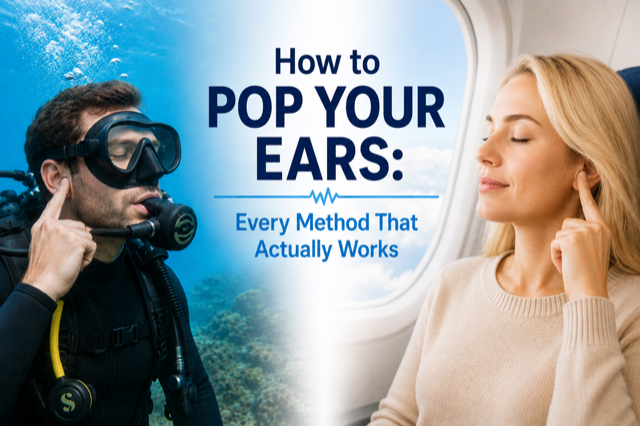
How to Pop Your Ears: Methods That Actually Work
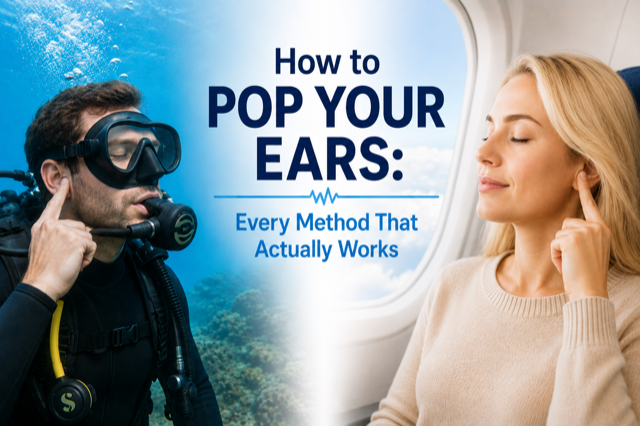
That tight, muffled, underwater feeling in your ears is one of the more universally annoying sensations a person can experience. It happens on planes, in elevators, driving through mountains, swimming, or even just from a stuffy nose. The good news is that “popping” your ears, technically called equalizing the pressure in your middle ear, is something you can almost always do yourself, safely, in under a minute. The key is understanding why your ears feel blocked in the first place, because that determines which method will actually work for you.
Why Your Ears Feel Clogged in the First Place
Your middle ear is a small chamber filled with air, sealed off from the outside world by your eardrum. The only connection it has to the rest of your body is the Eustachian tube, a narrow passage that runs from the middle ear down to the back of your throat and nose. Normally, this tube opens briefly every time you swallow or yawn, letting a tiny puff of air in or out to keep the pressure on both sides of your eardrum equal.
Problems start when the outside air pressure changes faster than your Eustachian tube can keep up, or when the tube itself is blocked or swollen. This happens in a few common situations:
Air travel, especially during takeoff and landing, when cabin pressure changes quickly
Driving through mountains or changes in elevation
Scuba diving or swimming underwater, where water pressure increases rapidly with depth
Colds, allergies, or sinus infections, which cause swelling that narrows or blocks the Eustachian tube
Elevators in tall buildings
When the pressure can’t equalize, your eardrum gets pulled slightly inward or pushed slightly outward, which is what creates that stuffed, muffled, sometimes painful sensation. Popping your ears simply means forcing the Eustachian tube open long enough to let air move through and equalize the pressure.
The Classic Methods (Start Here)
1. Swallowing
This is the simplest and safest method, and it’s often all you need for mild pressure changes. Swallowing activates the muscles that open the Eustachian tube. You can encourage this by:
Sipping water
Chewing gum
Sucking on hard candy
This is why flight attendants hand out candy during takeoff and landing, since it keeps you swallowing frequently, which continuously equalizes pressure as the cabin changes altitude. If you feel pressure building during a flight, don’t wait until your ears hurt to start swallowing; do it preemptively and often during ascent and descent.
2. Yawning
Yawning stretches the muscles around the Eustachian tube even more forcefully than swallowing does, which is why a big yawn often produces a very satisfying pop. You can trigger a yawn deliberately by opening your mouth wide and inhaling deeply, even if you don’t feel naturally sleepy. Combining a yawn with a swallow at the peak of the stretch tends to work even better than either alone.
3. The Valsalva Maneuver
This is probably the most well known technique for popping ears, and for good reason: it’s effective and you can do it anywhere.
How to do it: 1. Take a breath in through your mouth. 2. Pinch your nostrils shut with your fingers. 3. Close your mouth. 4. Gently try to exhale through your nose, as if you’re trying to blow your nose while it’s pinched shut. 5. You should feel a small pop or click as air pushes up through the Eustachian tube into the middle ear.
A word of caution: use gentle, steady pressure, not a hard, sudden blast of air. Blowing too forcefully can actually damage the eardrum or push mucus and bacteria from your nose into the middle ear, which can contribute to an ear infection. This is especially worth avoiding if you have a cold or sinus congestion, since the last thing you want is to push infected mucus into your middle ear space.
4. The Toynbee Maneuver
This method works the opposite way from the Valsalva maneuver, instead of pushing air up into the ear, it uses swallowing to create pressure changes while your nose is closed off.
How to do it: 1. Pinch your nostrils shut. 2. Take a sip of water, or simply swallow, while your nostrils remain pinched.
Some people find this gentler and more effective than the Valsalva maneuver, particularly for equalizing on descent, such as during a plane’s landing or when diving back up toward the surface.
5. The Frenzel Maneuver
This one is popular among scuba divers and pilots because it’s more controlled and doesn’t rely on lung pressure, which makes it safer for repeated use at depth.
How to do it: 1. Pinch your nostrils shut. 2. Close the back of your throat as if you’re about to lift something heavy, the same motion as grunting. 3. Make a “K” or “guh” sound with the back of your tongue while your nose and throat are sealed. This pushes the base of your tongue upward and back, compressing air in your throat and forcing it into the Eustachian tubes.
It takes a bit of practice to get the timing right, but many divers prefer it because it doesn’t rely on air from the lungs, so you can do it repeatedly without running low on breath, and it puts less strain on the eardrum than a hard Valsalva.
Gentler Methods for Sensitive Ears or Kids
6. The Lowry Technique
This combines the Valsalva and Toynbee maneuvers into one motion: pinch your nose, then swallow while gently trying to blow out through your nose at the same time. Some people find this combination more effective than either method alone, since it engages both the throat muscles and the air pressure push simultaneously.
7. Jaw Movement and Chewing Motions
Moving your jaw side to side, opening it wide, or mimicking a chewing motion, even without gum, can help open the Eustachian tube. This is a good option for young children who can’t reliably perform a Valsalva maneuver, or for anyone whose ears feel only mildly pressured rather than painfully blocked.
8. Nursing or Bottle Feeding (for Infants)
Babies can’t intentionally pop their ears, but the sucking and swallowing motion involved in nursing or bottle feeding does the job for them. This is why it’s often recommended to feed an infant during takeoff and landing on a flight, since it keeps them swallowing at the exact moments pressure is changing fastest.
Tools and Products That Can Help
9. Pressureze Nasal Mist
Pressureze Nasal Mist is a saline based nasal spray designed to work alongside the classic maneuvers above rather than replace them. It contains no drugs, steroids, chemicals, or preservatives, just a blend of purified water and specialty salts, meant to loosen and flush mucus from the sinus and ear canals so the Eustachian tube can open more easily. It’s packaged in a sealed, single direction valve system designed to stop backflow and re contamination between uses, and the manufacturer states it’s produced in an FDA registered, sterilized facility.
Because it’s not a medication, it doesn’t carry the rebound congestion risk that comes with overusing a decongestant spray (more on that below), and the manufacturer states it can be used daily, as often as needed. The maneuvers, swallowing, yawning, Valsalva, Toynbee, Frenzel, are what actually force air through the Eustachian tube to equalize pressure; Pressureze’s role is to keep the passage itself clear and moist so those maneuvers have an easier time working. That’s why it’s generally used shortly before an anticipated pressure change, before a flight’s descent, before a dive, before driving into the mountains, rather than only after your ears already feel blocked. Some people also work it into a daily sinus routine on the theory that keeping the nasal and sinus passages consistently clear of dust, pollen, and mucus buildup makes it less likely that a Eustachian tube gets blocked in the first place, though as with any daily hygiene habit, consistency matters more than any single use.
10. EarPlanes and Pressure Regulating Earplugs
These are specialized earplugs with a small ceramic filter that slows down the rate of air pressure change reaching your eardrum, giving your Eustachian tubes more time to keep up naturally. They don’t force your ears to pop the way a maneuver does; instead, they make the whole process gentler and less noticeable. They’re popular with frequent flyers and people who reliably get ear pain during flights. The downsides are minor but worth knowing: they only slow pressure change rather than actively clearing a blockage, so they won’t help much if your Eustachian tube is already swollen shut from congestion, and some people find earplugs uncomfortable for a full flight.
11. Nasal Decongestant Sprays
If your ears feel blocked because of congestion from a cold, allergies, or a sinus infection, the underlying problem is swelling in the tissue around the Eustachian tube opening, not just a pressure imbalance. In these cases, a decongestant nasal spray available over the counter (such as one containing oxymetazoline) taken about 30 minutes before a flight or dive can shrink that swelling and make it much easier for the tube to open. The tradeoff is that these sprays generally shouldn’t be used for more than three consecutive days, since overuse leads to rebound congestion (rhinitis medicamentosa), where your nose becomes dependent on the spray and gets more congested than before once you stop.
It’s also worth knowing that medicated sprays and drops meant for multiple uses aren’t immune to manufacturing problems. In recent years the FDA has recalled several over the counter eye drops and at least one nasal spray after inspectors found bacterial contamination tied to unsanitary conditions at the manufacturing facility, in some cases linked to serious infections. It’s not a reason to avoid every spray on the shelf, but it’s a fair reason to pay attention to how and where a product is made.
12. Oral Decongestants and Antihistamines
Oral decongestants (like pseudoephedrine) and antihistamines can also reduce Eustachian tube swelling, particularly if allergies are the underlying cause of your congestion. These take longer to kick in than nasal sprays, so they’re best taken an hour or more before you anticipate a pressure change, such as before heading to the airport. Their downsides are the classic tradeoffs of oral medication: pseudoephedrine can cause jitteriness, elevated heart rate, or trouble sleeping and isn’t recommended for people with high blood pressure or certain heart conditions, while older antihistamines can cause drowsiness. Both are systemic medications, meaning they affect your whole body rather than just the area that needs help.
13. Handheld Autoinflation Devices
For people with chronic Eustachian tube dysfunction, doctors sometimes recommend a small handheld device, often used originally for children, that involves blowing up a balloon through one nostril while pinching the other closed. This creates positive pressure in the nasal cavity that pushes air into the Eustachian tube, similar to a very controlled Valsalva maneuver. These are available over the counter and are sometimes recommended by ENT doctors for both children and adults with recurring ear pressure problems.
Method for Underwater Pressure (Diving and Swimming)
Popping your ears while swimming or diving deserves its own mention because the physics are different from air travel. Water pressure increases roughly twice as fast as air pressure per unit of depth, so equalization needs to happen early and often, ideally every couple of feet as you descend, not just when you start to feel pain.
Divers are generally taught to: * Equalize before they feel any pressure at all, starting right at the surface * Use the Frenzel maneuver or a gentle Valsalva, repeated frequently during descent * Never dive or force equalization with a cold or congestion, since the combination of blocked tubes and increasing water pressure raises the risk of eardrum injury significantly
If you ever feel sharp pain while diving that doesn’t resolve with equalization, the correct response is to stop descending and ascend slightly until the pain eases, rather than pushing through it.
What to Avoid
A few habits are common but can make things worse rather than better:
Don’t blow too hard during a Valsalva maneuver. Forceful blowing can injure the eardrum or push mucus laden with bacteria into the middle ear.
Don’t try to force a pop repeatedly if it isn’t working. If gentle attempts aren’t producing relief after several tries, forcing harder usually just causes pain rather than success.
Avoid flying, diving, or forcing equalization with a bad cold or sinus infection if you can help it, since the swelling that comes with congestion is often the actual root cause of a stuck ear, and forcing air through a blocked tube increases the risk of injury or infection.
Don’t rely on cotton swabs or anything inserted into the ear canal. Ear popping happens through the Eustachian tube in the back of your throat, not the ear canal itself, so nothing you do at the opening of your ear will address pressure in the middle ear. Inserting objects into the ear canal also risks injuring the eardrum.
When Ear Popping Methods Aren’t Enough
Most of the time, one of the methods above will resolve pressure related ear discomfort within a few minutes. But if your ears remain painfully blocked for more than a day or two after a flight or a cold, or if you experience any of the following, it’s worth checking in with a doctor:
Ongoing pain or a feeling of fullness that doesn’t improve
Ringing in the ears (tinnitus) that persists
Any drainage from the ear
Sudden or significant hearing loss
Dizziness or vertigo
These can be signs of a more significant Eustachian tube dysfunction, fluid buildup behind the eardrum, an ear infection, or in rare cases from diving, barotrauma to the eardrum, all of which may need treatment beyond simple maneuvers for equalizing pressure.
The Bottom Line
Most sensations of a clogged ear come down to a simple mismatch in air pressure across your eardrum, and your body already has a built in tool for fixing it: the Eustachian tube. Swallowing, yawning, and gentle maneuvers like Valsalva, Toynbee, and Frenzel all work by activating that tube in slightly different ways, so if one method doesn’t do the trick, it’s worth trying another rather than assuming nothing will work. For people who deal with this regularly, frequent flyers, divers, or anyone prone to congestion, pairing these techniques with tools like earplugs that regulate pressure or a decongestant can make the whole experience far less uncomfortable. And when your ears stay blocked well beyond the moment that caused it, that’s the signal to get it checked rather than keep trying to pop your way through it.
This article is for general informational purposes only and is not a substitute for professional medical advice. Product claims described here reflect manufacturer marketing and have not been independently verified. If you experience severe or persistent ear pain, hearing changes, or symptoms after flying, consult a licensed healthcare provider or an ear, nose, and throat specialist.