
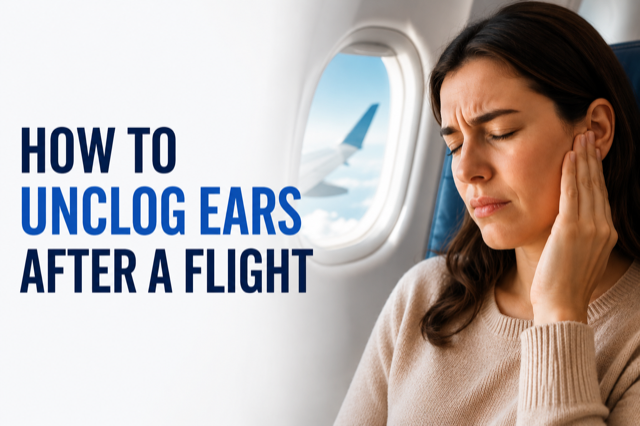
How To Unclog Ears After a Flight
Simple techniques, expert-backed tips, and a smarter way to help prevent the problem before it starts.
If you've ever stepped off an airplane feeling like your head is underwater, you already know how uncomfortable — and sometimes alarming — clogged ears can be. That muffled, pressurized sensation is one of the most common complaints among air travelers, and it can linger for minutes, hours, or even days after landing. The good news is that in most cases, it's a temporary and harmless side effect of changing altitude. The better news is that there are proven ways to relieve it quickly, and even better ways to stop it from happening in the first place.
In this guide, we'll break down exactly why your ears clog during a flight, walk through the most effective methods for clearing them once you're back on the ground, and introduce a simple travel companion — Pressureze Nasal Mist — that's designed to make the entire process faster and far more comfortable.
Why Do Ears Clog During and After Flights?
To understand how to fix clogged ears, it helps to understand what's actually happening inside your head. Your middle ear is an air-filled space that needs to stay at the same pressure as the air around you. It's connected to the back of your throat and nose by a narrow passage called the Eustachian tube. This tube's job is to open briefly every time you swallow, yawn, or chew, letting air flow in or out to equalize pressure.
On the ground, this happens automatically and you never notice it. But inside an airplane cabin, pressure changes far more quickly than your Eustachian tube can naturally keep up with — especially during takeoff and, even more so, during descent. As the plane climbs, cabin pressure drops, and the air in your middle ear expands and pushes outward through the tube fairly easily. As the plane descends, though, cabin pressure rises quickly, and outside air needs to push back into the middle ear against a narrower, often congestion-swollen tube. This is why descent is typically the more painful and stubborn half of the equation.
When the Eustachian tube can't equalize fast enough, the eardrum gets pulled or pushed slightly out of its normal position. The result is that familiar clogged, muffled, sometimes achy feeling commonly known as "airplane ear," or medically as ear barotrauma.
Common Triggers That Make It Worse
Colds and sinus congestion: Swollen nasal tissue narrows the Eustachian tube, making equalization harder.
Allergies: Inflammation from seasonal or environmental allergies has the same narrowing effect.
Sleeping through descent: You're not swallowing or yawning as often, so pressure builds up unchecked.
Rapid altitude changes: Short, steep descents on smaller regional aircraft can be especially tough on the ears.
Dehydration: Dry cabin air can thicken mucus, making the Eustachian tube more prone to blockage.
How To Unclog Your Ears After a Flight
If you've landed and your ears are still clogged, don't panic — most cases resolve within a few hours using simple, at-home techniques. Here are the most effective methods, ranked roughly from easiest to most involved.
1. Swallow, Yawn, or Chew Gum
This is the simplest fix and often the first thing worth trying. The muscles involved in swallowing and yawning physically pull open the Eustachian tube. Chewing gum encourages more frequent swallowing without you having to think about it, which is why flight attendants often hand it out before descent. If your ears are still clogged after landing, keep chewing gum or sipping water steadily for the next 20–30 minutes.
2. Try the Valsalva Maneuver
This classic technique is taught to divers and pilots alike. Pinch your nostrils shut, close your mouth, and gently blow as if you're trying to exhale through your nose. Done correctly, you should feel or hear a small "pop" as air pushes into the middle ear. Use gentle pressure only — blowing too hard can actually cause damage to the eardrum.
3. Use the Toynbee Maneuver
Pinch your nose closed and swallow. This creates a slightly different pressure dynamic than the Valsalva maneuver and works well for people who find blowing uncomfortable or ineffective.
4. Apply a Warm Compress
Holding a warm, damp washcloth against the affected ear for several minutes can help relax tissue around the Eustachian tube and encourage drainage, particularly if congestion is part of the problem.
5. Stay Upright and Hydrated
Gravity and hydration both help thin and drain mucus that may be contributing to the blockage. Sipping water frequently and avoiding lying flat for the first hour or two after landing can speed up relief.
6. Use a Saline Nasal Rinse or Mist
Because the Eustachian tube connects directly to your nasal passages, reducing nasal congestion is one of the most reliable ways to relieve ear pressure. This is where a purpose-built nasal mist becomes especially useful — more on that shortly.
When to see a doctor: If ear pain is severe, if you notice fluid or blood draining from the ear, if hearing loss persists beyond a day or two, or if you experience dizziness that doesn't resolve, it's time to consult a healthcare provider. These can be signs of a more significant barotrauma injury that needs professional care.
Why Most Saline Nasal Sprays Don't Work for Sinus Congestion
If you've landed and your ears are still clogged, don't panic — most cases resolve within a few hours using simple, at-home techniques. Here are the most effective methods, ranked roughly from easiest to most involved.
1. Swallow, Yawn, or Chew Gum
This is the simplest fix and often the first thing worth trying. The muscles involved in swallowing and yawning physically pull open the Eustachian tube. Chewing gum encourages more frequent swallowing without you having to think about it, which is why flight attendants often hand it out before descent. If your ears are still clogged after landing, keep chewing gum or sipping water steadily for the next 20–30 minutes.
2. Try the Valsalva Maneuver
This classic technique is taught to divers and pilots alike. Pinch your nostrils shut, close your mouth, and gently blow as if you're trying to exhale through your nose. Done correctly, you should feel or hear a small "pop" as air pushes into the middle ear. Use gentle pressure only — blowing too hard can actually cause damage to the eardrum.
3. Use the Toynbee Maneuver
Pinch your nose closed and swallow. This creates a slightly different pressure dynamic than the Valsalva maneuver and works well for people who find blowing uncomfortable or ineffective.
4. Apply a Warm Compress
Holding a warm, damp washcloth against the affected ear for several minutes can help relax tissue around the Eustachian tube and encourage drainage, particularly if congestion is part of the problem.
5. Stay Upright and Hydrated
Gravity and hydration both help thin and drain mucus that may be contributing to the blockage. Sipping water frequently and avoiding lying flat for the first hour or two after landing can speed up relief.
6. Use a Saline Nasal Rinse or Mist
Because the Eustachian tube connects directly to your nasal passages, reducing nasal congestion is one of the most reliable ways to relieve ear pressure. This is where a purpose-built nasal mist becomes especially useful — more on that shortly.
When to see a doctor: If ear pain is severe, if you notice fluid or blood draining from the ear, if hearing loss persists beyond a day or two, or if you experience dizziness that doesn't resolve, it's time to consult a healthcare provider. These can be signs of a more significant barotrauma injury that needs professional care.
The Smarter Approach: Prevent It Before It Starts
While the techniques above are effective once your ears are already clogged, frequent flyers know that prevention is far more comfortable than the cure. Since ear pressure problems are caused by a narrow, poorly equalizing Eustachian tube, the smartest strategy is to keep your nasal passages as clear and open as possible before pressure changes even happen — specifically right before takeoff and right before descent, the two moments when your ears are working hardest to keep up.
This is exactly the gap that Pressureze Nasal Mist was designed to fill.
Why wait to have an ear pressure problem? Use Pressureze to help avoid the ear pressure problems before they start. Don't let ear pressure problems ruin your vacation or important out-of-town meeting — use Pressureze prior to the ear pressure issues arriving, so you can step off the plane ready to enjoy your trip instead of nursing muffled, aching ears.
Frequently Asked Questions About Sinus Congestion Relief
While the techniques above are effective once your ears are already clogged, frequent flyers know that prevention is far more comfortable than the cure. Since ear pressure problems are caused by a narrow, poorly equalizing Eustachian tube, the smartest strategy is to keep your nasal passages as clear and open as possible before pressure changes even happen — specifically right before takeoff and right before descent, the two moments when your ears are working hardest to keep up.
This is exactly the gap that Pressureze Nasal Mist was designed to fill.
Why wait to have an ear pressure problem? Use Pressureze to help avoid the ear pressure problems before they start. Don't let ear pressure problems ruin your vacation or important out-of-town meeting — use Pressureze prior to the ear pressure issues arriving, so you can step off the plane ready to enjoy your trip instead of nursing muffled, aching ears.
The Bottom Line: Don't Settle for a Nasal Spray That Doesn't Work
While the techniques above are effective once your ears are already clogged, frequent flyers know that prevention is far more comfortable than the cure. Since ear pressure problems are caused by a narrow, poorly equalizing Eustachian tube, the smartest strategy is to keep your nasal passages as clear and open as possible before pressure changes even happen — specifically right before takeoff and right before descent, the two moments when your ears are working hardest to keep up.
This is exactly the gap that Pressureze Nasal Mist was designed to fill.
Why wait to have an ear pressure problem?
Use Pressureze to help avoid the ear pressure problems before they start. Don't let ear pressure problems ruin your vacation or important out-of-town meeting — use Pressureze prior to the ear pressure issues arriving, so you can step off the plane ready to enjoy your trip instead of nursing muffled, aching ears.
Introducing Pressureze Nasal Mist
Pressureze Nasal Mist is a fast-acting, travel-sized nasal spray formulated specifically to support clear, comfortable ears during air travel. Instead of waiting until you land to deal with a clogged, achy feeling, Pressureze is designed to be used proactively — giving your Eustachian tubes the best possible chance to equalize naturally as cabin pressure shifts.
How Pressureze Works
Pressureze delivers a fine, evenly dispersed mist directly to the nasal passages, where it helps reduce tissue swelling and clear mucus that can narrow or block the Eustachian tube. With clearer nasal passages, air can move more freely between your throat and middle ear, making it far easier for your ears to equalize pressure on their own — whether the plane is climbing or descending.
The Advantages of Pressureze Nasal Mist
Fast-acting formula: Designed to start working quickly, so there's no long wait between application and relief.
Convenient, travel-friendly size: Fits easily in a carry-on, purse, or pocket, and meets standard carry-on liquid size guidelines.
Simple, one-hand application: A quick spray is all it takes — no complicated routine required, even in a cramped airplane seat.
Supports natural equalization: Rather than masking discomfort, it helps your body's own pressure-equalizing system work the way it's supposed to.
Versatile timing: Effective when used after a flight to relieve existing pressure, and even more effective when used proactively before takeoff and before descent.
Non-habit forming, easy-to-use design: Formulated for regular travelers who want a reliable part of their pre-flight routine, not an occasional emergency fix.
Great for congestion-prone flyers: Especially helpful for travelers dealing with allergies, mild colds, or sinus sensitivity, whose Eustachian tubes are already more prone to blockage.
Best Practices: How To Use Pressureze for Maximum Relief
While many travelers reach for Pressureze Nasal Mist only after they've already landed with clogged ears — and it does provide welcome relief in that moment — the real advantage comes from using it proactively. Here's the routine frequent flyers recommend:
Before takeoff: Apply Pressureze roughly 15–30 minutes before boarding or as the plane prepares for departure. This gives your nasal passages time to clear before the cabin begins its initial climb, when pressure first starts to shift.
Before descent: This is the most important moment to use it. Descent is when most people experience the sharpest pressure pain, since outside air needs to push back into the middle ear through a tube that hasn't had to work this way since before takeoff. Apply Pressureze as soon as the flight crew announces the beginning of descent, giving it time to work before cabin pressure rises.
After landing (if needed): If your ears still feel full or muffled after touchdown, a follow-up application can help finish clearing residual pressure or congestion.
Pro tip: Pair Pressureze with active equalization techniques like swallowing, yawning, or the Valsalva maneuver during descent. The mist helps keep your nasal passages clear, while these techniques help physically open the Eustachian tube — together, they address both sides of the equalization problem.
Who Benefits Most From Using Pressureze?
While any traveler can experience clogged ears, certain groups tend to notice the biggest difference when they add Pressureze to their travel routine:
Frequent flyers who deal with recurring ear discomfort on nearly every trip.
Travelers with seasonal allergies whose nasal passages are already more prone to swelling.
Anyone flying with a mild cold or lingering congestion who still needs to travel.
Parents traveling with children, since kids' narrower Eustachian tubes can make them especially prone to ear pain during flights.
Frequent business travelers who can't afford to land with hours of muffled hearing before an important meeting.
Other Habits Worth Building Into Your Travel Routine
Pressureze works best as part of a broader in-flight comfort routine. A few additional habits can further reduce your chances of landing with clogged ears:
Stay awake during descent so you can actively swallow, yawn, or use equalization techniques as pressure builds.
Avoid excessive alcohol or caffeine before flying, since both can contribute to dehydration and thicker mucus.
Consider an antihistamine the day before travel if you know you're prone to allergy-related congestion — just check with a pharmacist or doctor first.
Bring gum or hard candy as a simple backup that encourages frequent swallowing throughout the flight.
Wear specialty filtered earplugs if you've had persistent ear pain on past flights, as these are designed to slow pressure changes reaching the eardrum.
The Bottom Line
Clogged ears after a flight are common, usually harmless, and almost always temporary. Simple techniques like swallowing, chewing gum, the Valsalva maneuver, and staying hydrated can bring relief within a short time after landing. But if you'd rather avoid the problem altogether — or at least minimize it significantly — the smarter move is to get ahead of it.
That's the real value Pressureze Nasal Mist brings to the table. Rather than treating discomfort only after it happens, it's designed to be part of your pre-flight and pre-descent routine, helping your nasal passages and Eustachian tubes stay clear right when pressure changes hit hardest. Used consistently — before takeoff, before descent, and again after landing if needed — it can turn one of air travel's most universal annoyances into a total non-issue.
Next time you fly, don't wait until your ears are already clogged to do something about it. Pack Pressureze, use it at the right moments, and land ready to enjoy your destination instead of shaking your head trying to pop your ears clear.
Why wait to have an ear pressure problem? Use Pressureze to help avoid ear pressure problems in the first place. Don't let ear pressure ruin your vacation or an important out-of-town meeting — use Pressureze before the issue has a chance to arrive.
This article is for general informational purposes and does not constitute medical advice. If you experience severe or persistent ear pain, hearing loss, or dizziness after flying, please consult a licensed healthcare provider.